
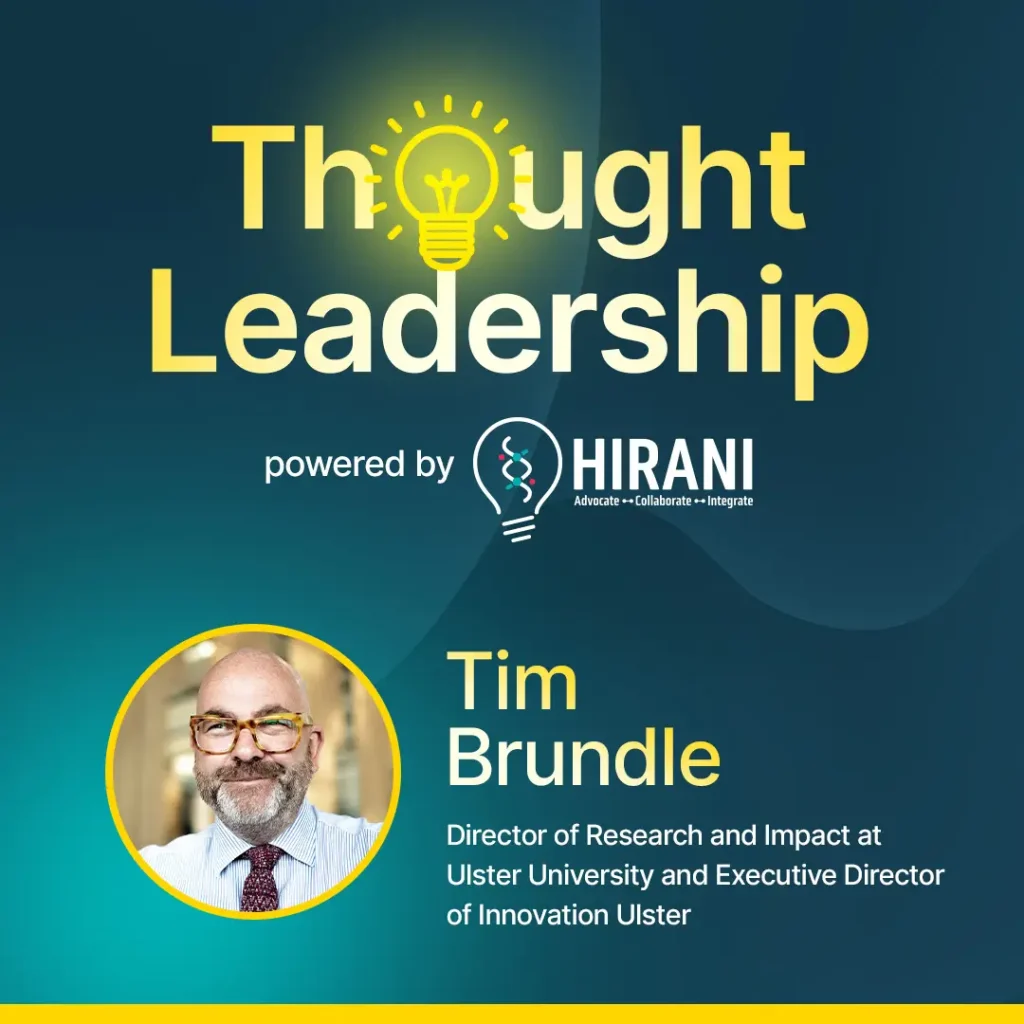
Hear from Tim Brundle, Director of Research and Impact at Ulster University and Executive Director of Innovation Ulster about the development of the health and life sciences ecosystem in NI over the past 35 years.
“Thirtyfive years ago, I stepped off a bus in Crumlin and walked into a local shop to ask for directions to Randox Laboratories.
“It was Youth Science Week, a programme that brought together schoolchildren from across Northern Ireland for lectures by leading academics, dramatic laboratory demonstrations, and, most importantly for me, the chance to visit emerging technology companies. The shopkeeper wasn’t entirely sure where the laboratory was, but he knew the Fitzgerald family. He pointed me in their direction. I was welcomed with tea and cake, shown diagnostic technologies at close quarters, and given my first lesson in clinical pathways. It was an unassuming moment, but one that set me on a path that would shape my career, and, in many ways, mirror the trajectory of Northern Ireland’s life sciences sector itself.
“That experience led me to study biotechnology, followed by biomedical sciences, inspired by the opportunity I sensed ahead. Around the same time, the first detailed cluster analysis of Northern Ireland’s life sciences sector was published. It identified something that was modest in scale but highly scalable, an observation that remains remarkably accurate today.
“Northern Ireland’s life sciences story did not begin in the 1990s. Its roots extend back decades earlier, notably to Professor Frank Pantridge’s invention of the portable defibrillator in the 1960s. That breakthrough set a powerful precedent: a clinically driven innovation that delivered global impact from a small region.
“The following decades saw sustained investment by Queen’s University Belfast and Ulster University in the biomedical sciences. By the 1980s and 1990s, global reputations had been established in areas such as cancer, cardiovascular disease, and cystic fibrosis. These strengths were significant enough to be showcased on the international stage by Taoiseach Bertie Ahern at Ireland’s first biotechnology conference at the turn of the century. Across the island, biotechnology became a cornerstone of the Celtic Tiger economy. In the Republic of Ireland, a combination of low corporate tax, EU market access, and a highly educated workforce attracted major pharmaceutical companies. Government programmes offered by Science Foundation Ireland fostered strong university–industry collaboration, shifting the sector from manufacturing toward highvalue R&D and proprietary products.
“Northern Ireland’s experience was more complex. Yet despite structural and historical challenges, entrepreneurs, researchers, and clinicians continued to build foundations that would later prove transformative. One key company that illustrates this approach was Randox Laboratories. Founded in Crumlin in 1982 by Dr Peter FitzGerald, Randox grew from a team of six into a global diagnostics leader. Today, it employs more than 3,300 people worldwide, including around 650 scientists and engineers, and serves customers in over 145 countries. The Randox Biochip Array Technology, enabling multimarker testing on a single sample, has reshaped diagnostics across cancer, cardiac disease, infectious diseases, environmental testing, and forensic toxicology.
“Alongside industrial leadership sat equally important contributions from academic entrepreneurs. Professor John Anderson, a Belfast native and Director at Ulster University, was instrumental in establishing bioengineering as a discipline in Northern Ireland. His work spanned clinical leadership at the Royal Victoria Hospital, development of portable defibrillator technologies, and the founding of the Northern Ireland BioEngineering Centre. Through more than 300 publications, 40 patents, and multiple spinout companies, including HeartSine and Intelesens, John exemplified how deep research, entrepreneurship, and clinical collaboration could be translated into global products and highvalue employment. His legacy remains embedded in Ulster University’s approach to medical technology innovation.
“By the early 2000s, momentum was building. The formation of Invest Northern Ireland in 2002 marked a more assertive international positioning of the region as a destination for life and health sciences that combined talent, cost competitiveness, regulatory connectivity, and an increasingly coherent innovation ecosystem. By 2015, the sector comprised around 250 companies which exported to more than 140 countries. A 2022 assessment valued Northern Ireland’s life sciences industry at approximately £2.4 billion, supporting nearly 20,000 direct jobs and a further 15,000 indirectly. As of 2025, Northern Ireland ranks among the UK’s fastestgrowing life sciences clusters, operating across biotech, diagnostics, medtech, clinical trials, and digital health. From small beginnings, the sector has become globally competitive, saving lives around the world.
“Today, the future of Northern Ireland’s life sciences sector is increasingly shaped by a new generation of female founders leading internationally focused, researchintensive companies rooted firmly in the region. Leaders such as Suzanne Saffie Siebert of SiSaf; Queen’s University Belfast’s Helen McCarthy, now Chief Scientific and Technology Adviser for Northern Ireland; Sian Farrell and Bridgen Callan of Ulster University spinouts StimOxygen and KLAS Therapeutics; and Pragya Sharma of Granlab exemplify how Northern Ireland’s life sciences ecosystem is maturing in line with regional policy ambitions around innovationled growth, economic diversification, and the translation of publicly funded research into commercial and societal value.
“Suzanne Saffie Siebert’s leadership of SiSaf demonstrates how capitalintensive science can be commercialised from Northern Ireland while competing globally, exemplifying the type of highvalue, knowledgedriven enterprise envisaged within industrial and innovation strategy. Professor Helen McCarthy’s transition from academic leadership at Queen’s University Belfast into the role of Chief Scientific and Technology Adviser underscores the growing role of scientific evidence and technological insight in shaping public policy, strengthening the interface between universities, industry, and government. Through StimOxygen and KLAS Therapeutics, Ulster University spinout founders Sian Farrell and Bridgen Callan illustrate how translational research pipelines contribute directly to policy objectives around spinout creation, patient impact, and the retention of intellectual property and talent within the region. Pragya Sharma and Granlab highlight the strategic importance of platformbased life sciences businesses, anchoring international value chains locally while supporting export growth, inward collaboration, and highskill employment.
“Importantly, their journeys are increasingly supported by the Universities themselves and by organisations such as HIRANI, Women in Business NI, AwakenHub, Invest NI, and Innovate UK. Collectively, these institutions provide access to capital, networks, skills development, and international exposure, with these leaders now featuring prominently in global trade missions, competitive funding programmes, and seniorlevel policy discussions. Together, they demonstrate how entrepreneurial leadership, institutional capability, and targeted public intervention can reinforce one another to deliver sustained, internationally competitive impact for Northern Ireland.
“Northern Ireland’s life sciences journey, from early clinical innovation, through academic excellence, to global commercialisation, is one of transformation. Yet growth alone is not enough. What is now required is a renewed call to arms: deeper access to scaleup capital, stronger founder pathways, and continued alignment between universities, industry, investors, and government. The ingredients are present. The ambition is evident. The international market opportunity is clear. The next chapter of Northern Ireland life sciences will be defined not by potential, but by the decisions we make now to invest, to collaborate, and to build at scale.”
Find out more and connect with Tim here: Tim Brundle – Director of Research and Impact – staff