
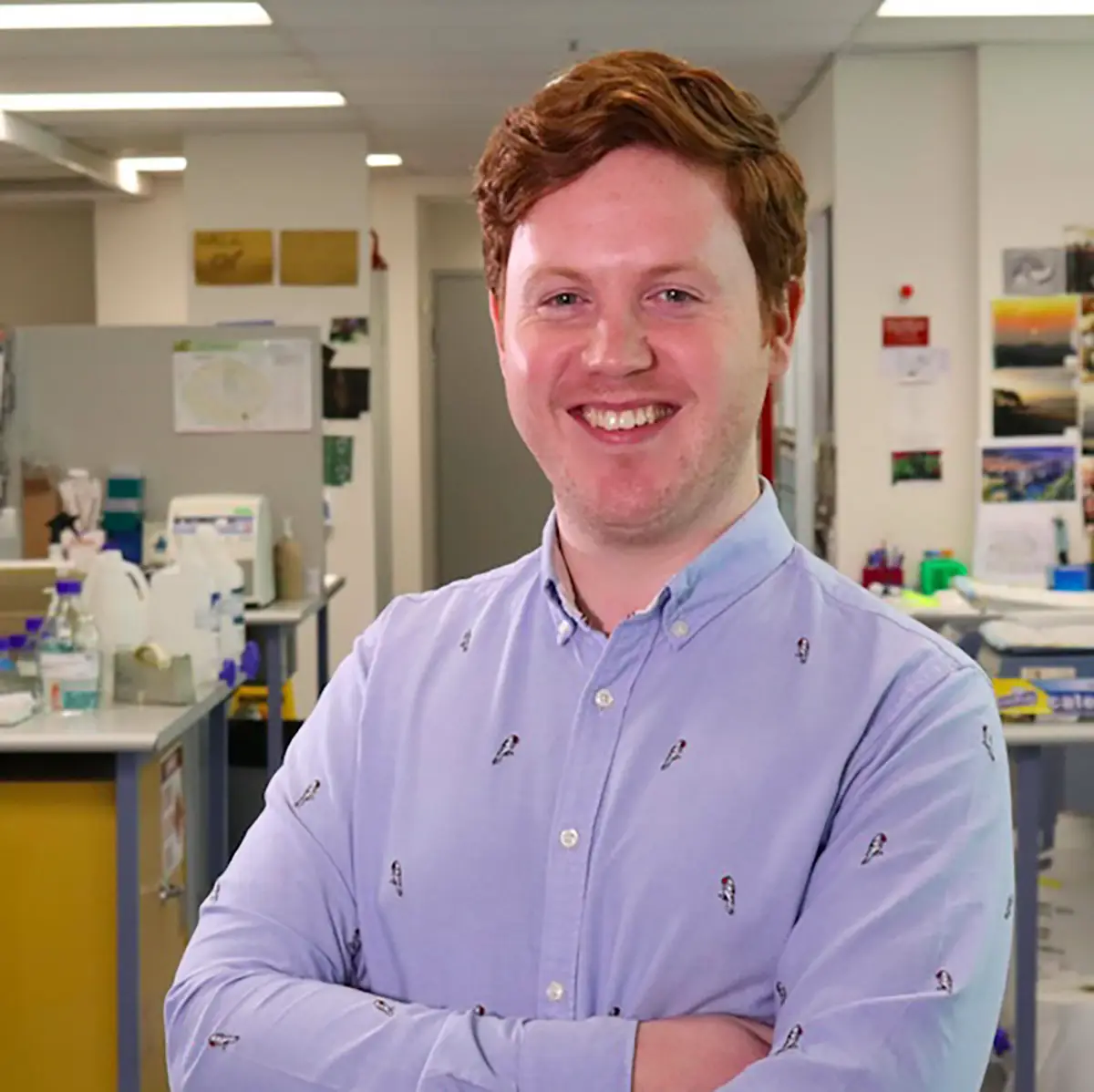
Dr. Niall M Byrne, Chief Scientific Officer and co-founder of BXTA Nanotherapy Ltd.
BXTA Nanotherapy Ltd is an innovative medtech company advancing the development and commercialisation of nanotherapeutics, specifically gold nanoparticles, to improve treatment outcomes for patients with cancer.
The problem: Radiotherapy remains the primary treatment option for many cancers, including localised prostate cancer, where around half of men are treated with curative intent. Despite recent advances in how radiotherapy is delivered, treatment still fails for roughly 20–30% of men with unfavourable intermediate- to high-risk disease; around 3,500 men per year in the UK. Even when radiotherapy succeeds, it can damage neighbouring healthy tissue, including the bladder and bowel, significantly impacting patient quality of life. With global prostate cancer cases predicted to double to almost 3 million by 2040, novel interventions are required to enhance radiotherapy treatment outcomes.

The approach: We believe that gold nanoparticles are the solution to this clinical unmet need. When these nanoparticles are taken up within tumour cells, they can boost the killing effects of radiotherapy in a very localised area, helping to spare healthy tissue from damage. While the radiosensitising properties of gold have been studied for years, we have evolved this technology further, developing innovative solutions that capitalise on this known phenomenon.
The innovation: Our lead gold nanoparticle formulation – AuX2R – combines the physical radiation-enhancing properties of gold with proprietary molecular targeting approaches that can block cancer survival pathways. Specifically designed with translation in mind, AuX2R has been engineered to overcome the limitations that have hindered the clinical translation of other radiosensitisers. To-date, AuX2R has successfully completed substantial pre-clinical development and is now positioned to enter clinical investigation.
BXTA Nanotherapy: The idea that would eventually become AuX2R started in 2014, when Professor Jonathan Coulter at the School of Pharmacy, Queen’s University Belfast (QUB) secured funding from Prostate Cancer UK to explore novel approaches to make tumour cells more responsive to radiotherapy. Building on more than a decade of research in oncology, radiotherapy and nanoparticle science, several formulations were developed and tested at QUB by Dr Natalie Owen with support from Dr Dorian Dixon at Ulster University. I joined the team at QUB in 2019 under an MRC Confidence in Concept award to develop the technology further, and in 2021 we secured a competitive Invest NI Proof of Concept award, allowing us to build on the AuX2R pre-clinical dataset.
This dataset, combined with real-world validation gathered through the North by Northwest Lean Launch Programme and the Innovate UK-funded ICURe pre-accelerator programme, gave us the confidence, and the evidence, to look for a commercial partner to drive forward the clinical and commercial development of AuX2R. Following an introduction by Prostate Cancer UK, BXTA Nanotherapy Ltd was incorporated in early 2023 as a joint venture between QUB and BXTAccelyon Ltd, accelerating the development, regulatory approval, and commercialisation of AuX2R. This partnership leveraged the technology and intellectual property originating from QUB, with the extensive regulatory, commercial and market expertise of BXTAccelyon, a leading UK-headquartered international uro-oncology business, led by Malcolm Hughes, Saheed Rashid and Guy Pettigrew.
As Chief Scientific Officer, my role is to lead the scientific and technical development of AuX2R and second generation nanotherapeutics, from formulation through to the pre-clinical evidence base that will support our move into clinical trials. Working alongside Professor Coulter, Chief Technical Officer of BXTA Nanotherapy, we are supported by a growing team of research scientists with expertise in cancer and radiation biology, nanotherapeutics and immunoncology. We have assembled an international team of leading healthcare professionals from radiation oncology, medical physics and uro-oncology who constitute our clinical advisory panel (CAP), providing robust scientific and clinical feedback. Combined with experts advising on manufacturing, trial design/management, regulatory affairs, finance & marketing, we are ideally positioned to drive the clinical and commercial development of our innovative nanotherapeutic, AuX2R.
Innovation in Northern Ireland: Our R&D is currently based within the health campus at QUB, and Northern Ireland has been the right place to build this. Locally, we’ve been fortunate to have been supported along our journey by QUB’s commercial development team and QUBIS, the commercialisation arm of QUB, who were instrumental in brokering the deal with BXTA. In Northern Ireland we have the ability to learn from and draw on a thriving life and health sciences ecosystem that combines strong university-driven innovation, with a proven track record of translational research and pharmaceutical manufacturing excellence. At QUB, the Future Medicines Institute (FMI) and the iREACH Health Innovation Centre, delivered through the Belfast Region City Deal, will provide access to cutting-edge resources and facilities for early-stage clinical studies. Together with support clusters like HIRANI, Northern Ireland is the ideal environment to take a university discovery through to a commercial product.
The future is golden: Looking ahead, our immediate priority is progressing AuX2R to scaled up clinical-grade manufacture and on into first-in-human trials. Initially these studies will assess safety in a small cohort of prostate cancer patients, before engaging in larger efficacy studies and pursuing the regulatory approvals needed for wider clinical use. Longer term, we envisage AuX2R being prescribed wherever radiotherapy is used with curative intent, not just in prostate cancer, and expanding from European markets into the US, Australia and Asia. We’re also actively growing our research and development team here in Northern Ireland to support that trajectory.
It’s an ambitious pathway, but one built on a decade of research, a strong commercial partnership, and a regional ecosystem that has backed us at every stage.