Our April company of the month, MindTrack 360 began with a simple realisation: great content means little if people can’t, or are not motivated to, fully engage with it.
In a previous role, the team developed a web-based psychosocial programme for people recovering from drug and alcohol misuse. The results were encouraging — users consistently described it as helpful, reflective, and supportive of real change. But there was a catch: many people didn’t get far enough through the modules to experience the full benefit.
CEO Daithi Conlon said: “This challenge became even clearer when we transitioned the business model from a self-paying direct-to-consumer approach to delivery through community groups and charities. Many participants struggled with sustained attention or found the literacy demands difficult. The content itself was strong — but the format was holding people back.
“So when Innovate UK launched the Mindset extended reality (XR) for digital mental health programme, we saw an opportunity to rethink the delivery method while keeping the same therapeutic principles.”
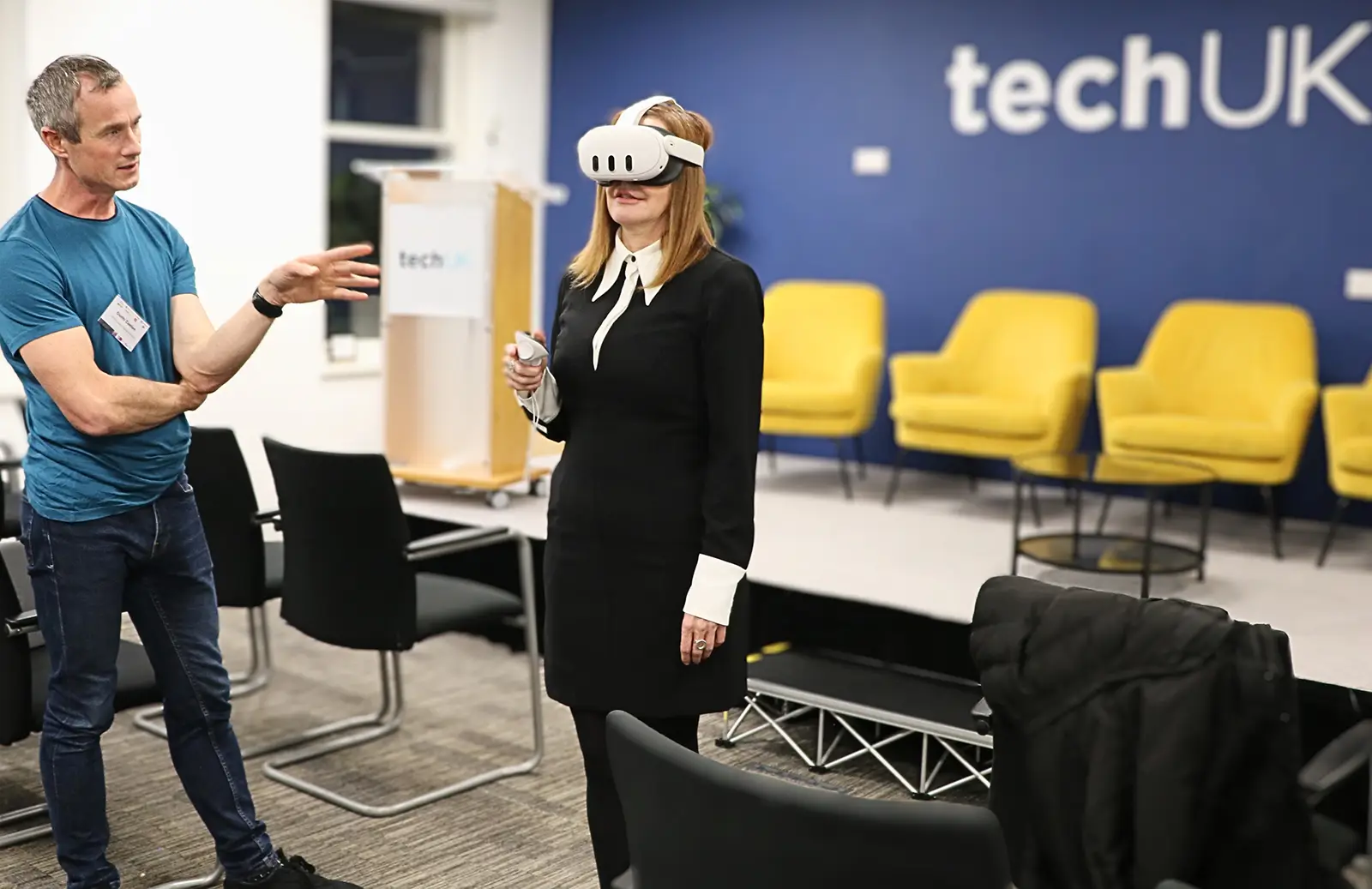
The first step was a simple VR proofofconcept built for a Meta Quest headset.
“Early testers reported feeling more absorbed, less distracted, and more able to focus. One even described entering a “flow state” within minutes.
“That early prototype sparked a fiveway collaboration with Queen’s University Belfast, immersive technology specialists eXRt, and two Northern Ireland charities — ASCERT and the Upper Springfield Development Trust. Together, they codesigned a fully VR-native psychosocial programme and an accompanying organisational portal to support realworld delivery.
“As CEO, I oversee the strategic direction of MindTrack 360 and bring together input from academic partners, service users, charities, VR developers and backend engineers.
“A central part of my role is ensuring that what we build is not only innovative, but practical and scalable, asking questions including:
- Does this genuinely help service users?
- Can it be delivered at scale?
- Will organisations find it usable and acceptable?
- Can it fit within a sustainable commercial model?
“I’m particularly driven by the challenge of widening access to reflective, psychosocial support — especially for people who struggle with reading, writing, or sustained concentration. Technology should remove barriers, not add new ones.”
MindTrack 360 is based in Northern Ireland with a mostly remote-working model supported by regular inperson collaboration.
“Northern Ireland has proved to be an ideal base — tightly connected, highly collaborative, and full of organisations willing to codevelop and innovate.
“We have received really valuable strategic support from Invest NI, Innovate UK and HIRA NI, helping us move from concept to live trials far more quickly than would otherwise have been possible.”
MindTrack 360 delivers a VRbased psychosocial support programme that helps people reflect on their relationship with drugs and alcohol and consider positive next steps.
Using guided 360° environments and an audio-based virtual coach, the programme reduces distractions and removes heavy text requirements. Responses are voice-led or interactionbased, making it accessible for people who struggle with traditional digital tools.
The programme can be used:
- independently at home
- in onetoone keyworker sessions
- in structured group settings
Organisations also receive access to a dedicated portal to manage participants, track engagement, and integrate the programme into existing pathways.
“MindTrack 360 isn’t a web programme placed inside a headset — it’s a VRfirst intervention built around immersion, focus, and low cognitive load.
Its innovations include:
- Minimal reliance on text
- Guided audio reflection
- Private, nonjudgemental spaces for personal insight
- Suitability for people who find standard interventions challenging
“Our enterprise model — combining immersive VR experiences with an organisational admin platform and a structured group delivery format — positions MindTrack 360 not just as a standalone app, but as scalable infrastructure that can be adopted by charities, community organisations, and health services.
“With the production-ready version complete, the next steps are exciting. This month (April 2026) we will begin structured trials with approximately 40 service users in partnership with ASCERT and USDT. This single-arm study will help us evaluate engagement, acceptability, and early outcomes, with findings used to guide further refinement and inform decisions about future scaling.
“We are also collaborating with Children’s Mental Health Services to explore a youth-focused adaptation of the programme. In parallel, we are exploring additional tracks focused on gambling and gaming behaviours, as well as potential applications within justice settings.
“Over the next 12 months, our focus is on demonstrating usability and acceptability in live settings, strengthening delivery partnerships, and establishing a sustainable commercial pathway for wider adoption.
The focus over the next 12 months is demonstrating realworld usability, strengthening delivery partnerships, and building a sustainable pathway for wider adoption.”
MindTrack 360 is now welcoming:
- Charities
- Community organisations
- Health services
- Justice-sector partners
who may be interested in acting as pilot sites.
Individuals interested in taking part in upcoming trials are also encouraged to get in touch.
Email: daithi@mindtrack360.com
Website: www.mindtrack360.com